
How Much Does a Website Cost in Canada in 2026
A website in Canada costs anywhere from a few hundred dollars a year for a do-it-yourself builder to well over $100,000 for a custom web application. For most small and mid-sized businesses, a professionally built site lands somewhere between about $3,000 and $25,000 as a one-time build, plus yearly costs for the domain, hosting, maintenance and content. This guide shows the general Canadian market ranges published in 2026, explains what moves a project up or down that scale, and shows how to read the quotes you receive so you can compare them fairly.
All figures are in Canadian dollars unless marked otherwise, exclude GST or HST, and were checked in November 2026. They describe the market as a whole. They are not Canada Create prices.
How much does a website cost in Canada? The short answer
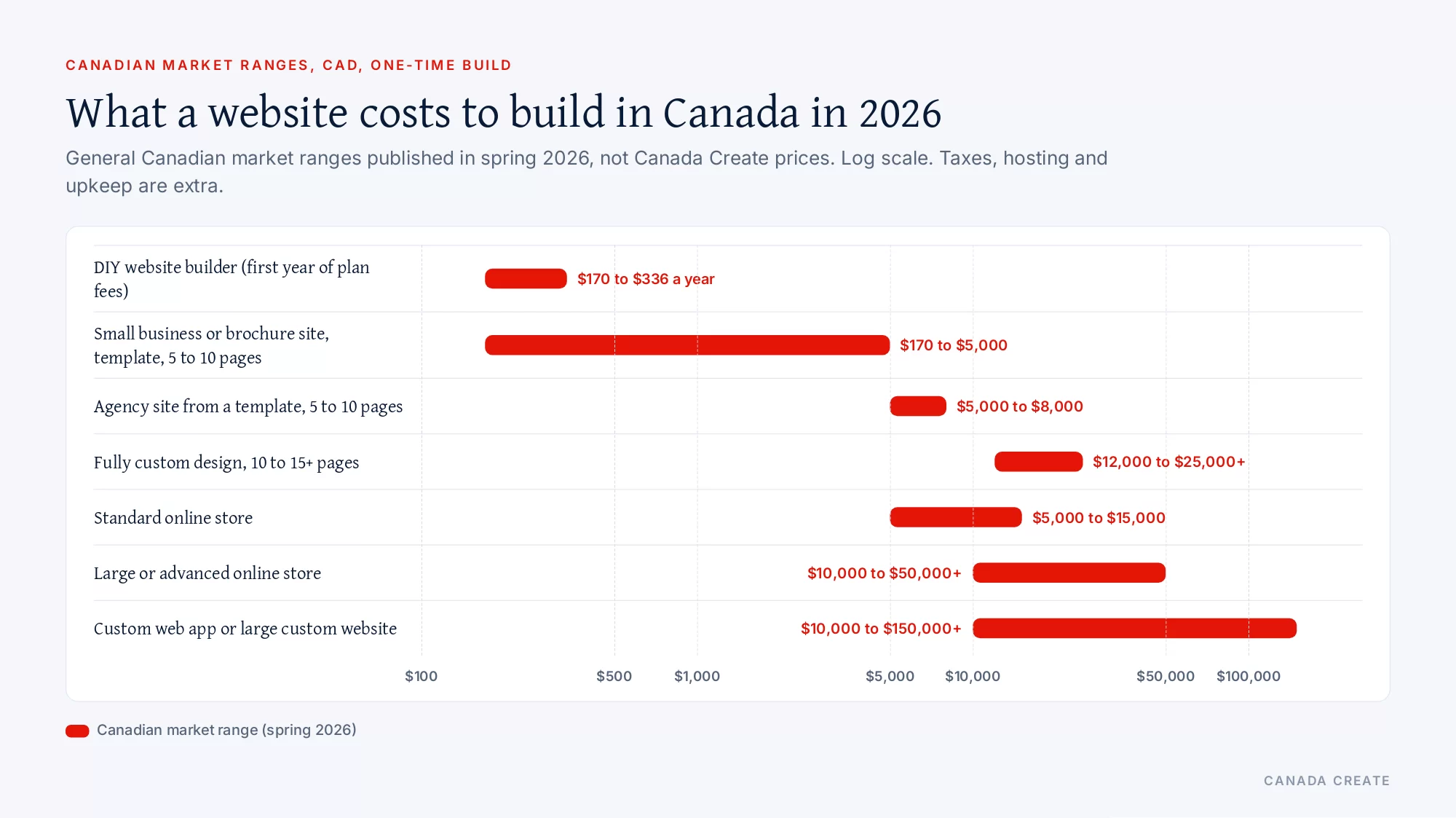
Canadian market ranges published in spring 2026 put the numbers in a similar place: a template-based small business site of 5 to 10 pages at about $500 to $5,000, a fully custom site of 10 to 15 or more pages at about $12,000 to $25,000, with most Canadian small businesses landing between $3,000 and $15,000. A brochure site runs from about $170 for a builder-made site up to $5,000 for a bespoke one, and an online store built by a web designer from $5,000 to $10,000.
These are general Canadian market ranges, not Canada Create prices. Canada Create quotes every project in writing after a free consultation.
| Type of website | General Canadian market range (spring 2026) |
|---|---|
| DIY website builder | About $0 build cost plus $25 to $60 a month ($170 to $336 a year) in builder fees |
| Small business or brochure site | $170 to $5,000 (template, 5 to 10 pages) |
| Agency site from a template, 5 to 10 pages | $5,000 to $8,000 |
| Fully custom design, 10 to 15+ pages | $12,000 to $25,000+ |
| Standard online store | $5,000 to $15,000 |
| Large or advanced online store | $10,000 to $50,000+ |
| Custom web app or large custom website | $10,000 to $150,000+ |
We design and build fast, accessible websites for Canadian businesses, with SEO built in from day one.
The ranges are wide because “a website” covers very different jobs. A five-page site for a renovation contractor in Scarborough and a bilingual online store with 2,000 products and a warehouse integration are both websites. The rest of this guide breaks the number into the parts that actually drive it.
What drives the cost of website design
Every quote, whatever the total, is built from the same handful of decisions. Understanding them is the fastest way to see why two quotes for “a five-page website” can differ by a factor of five.
Number of pages and unique layouts
Page count matters less than the number of distinct layouts. Twenty service pages that share one template cost far less than eight pages that each need their own design. Each additional page typically adds roughly $500 to $1,500 in design and setup. When you compare quotes, ask how many unique templates are being designed and how many pages are built from them.
Template or custom design
A theme or template gives you a tested structure quickly. A custom design starts from your brand, your buyers and your content, and every screen is drawn for your business. A template typically saves about $2,000 to $5,000 compared with a custom design. The trade-off is that a template is shared with other businesses and bends less when your needs change.
Content: copy, photos and video
Content is the line most often missing from low quotes. Someone has to write every page, choose or shoot photos, and get approvals from you. Professional copywriting in the Canadian market runs about $200 to $400 per page. If a quote assumes you will supply all the text and images, the project will wait on you, and the total you see is not the total you will spend.
Features and integrations
Forms are simple. Online booking, payments, a CRM connection, a member area, a product configurator or a multilingual setup are not. Typical Canadian market figures put online booking at about $500 to $2,000, a CRM integration at about $1,000 to $3,000 and ecommerce functionality at about $2,000 to $8,000 or more. Custom features built from scratch sit above those figures.
Platform
The platform decides both the build cost and the running cost. A hosted builder bundles hosting and software into a monthly fee. A self-hosted content management system such as WordPress costs nothing to license but needs hosting, updates and security care. A custom-coded application needs developers for every change. Our guide to website builders compared with hiring a designer covers that choice in more detail.
Search, speed and accessibility
A site that is meant to bring in enquiries needs clean structure, fast pages, correct titles and descriptions, structured data and analytics from launch day. Ontario businesses with 50 or more employees also have accessibility duties under the Accessibility for Ontarians with Disabilities Act, which affects design and testing time. Leaving these out makes a quote look cheaper and the site cost more later.

Website cost by type of site
One-page site or landing page
A single page for a campaign, an event or a new business is the smallest job. A landing page typically runs roughly $250 to $1,500, depending on length and features, with custom code costing more. A landing page built for paid ads needs fast loading, a clear offer and tracking, so it is worth more care than its size suggests. See landing page design for what a conversion-focused page includes.
Brochure or small business website
This is the most common project: home, about, services, a few service pages, contact, and often a blog. On the market ranges above, a template-based build sits in the low thousands and a custom-designed site of 10 to 15 pages in the low to mid tens of thousands. Most of the difference comes from custom design, the number of service and location pages, and whether the writing is included.
Online store
Ecommerce adds products, variants, payments, shipping rules, taxes for each province, inventory and order emails. Published 2026 Canadian ranges start a designer-built store at about $5,000; large or advanced stores run from about $10,000 to $50,000 and up. Product data entry and photography are often the hidden bulk of the work. Our post on factors that affect ecommerce website cost and the Canadian ecommerce website examples show where that budget goes.
Custom website or web application
Portals, booking engines, quoting tools, dashboards and marketplaces are software projects. They need discovery, user flows, a database, testing and a plan for hosting and support. The published ranges start around $10,000 to $30,000 and reach $100,000 to $150,000 or more. At this level, ask for the estimate to be broken down by feature so you can phase the build.
Website redesign
A redesign can cost as much as a new build, because the content usually needs rewriting and the old pages need redirects so search rankings carry over. A redesign that keeps the structure and content and changes only the look costs less. The part not to skip is the redirect map from every old URL to its new home.
DIY builder, freelancer or agency: what each costs
There are three ways to get a site built, and each trades money for time, skill and support.
Website builders
A hosted builder lets you make the site yourself. Plan fees are the main cost. On Shopify’s Canadian pricing page (checked November 2026), the Basic plan is $37 CAD a month billed yearly or $49 CAD a month billed monthly, Grow is $99 or $132, Advanced is $389 or $517, and Plus starts at $3,400 CAD a month, with card processing fees on top. Squarespace lists its website and commerce plans from US$19 to US$99 a month billed yearly, and WordPress.com lists paid plans from US$4 to US$45 a month billed yearly; both showed US dollars when checked, so confirm the Canadian price at checkout. Typical builder fees in Canada run $170 to $336 a year.
The fee is low; your time is the real cost. Builders suit a new business that needs a presence quickly, a hobby shop or a short campaign. They suit a business that depends on search and enquiries less well, because design and structure are limited by the template.
Freelancers
Canadian freelancers typically charge about $40 to $100 an hour, with typical projects around $1,500 to $7,000, roughly 20 to 50 per cent below agency pricing. For context on what the work pays as employment, the federal Job Bank wage data for web developers show a median of $39.42 an hour in the Toronto region and $38.46 nationally, and the same data for web designers shows $33.65 in Toronto and $31.25 nationally (reference period 2023 to 2024). Billing rates sit above wages because a freelancer pays for software, equipment, insurance, unpaid sales time and gaps between projects.
A strong freelancer is good value for a defined, smaller project. The risk sits in capacity: one person covers design, development, content and support, and the site waits when that person is busy or unavailable.
Agencies
Agency work typically runs about $5,000 to $8,000 for a template-based site of 5 to 10 pages and $12,000 to $25,000 or more for a fully custom build. The higher figure buys a team: strategy, design, development, writing, search, testing and project management, plus continuity when one person is away. An agency makes the most sense when the website is a sales channel that has to bring in calls, bookings or orders, and when it connects to ads, search and a CRM.
If you are weighing agencies in the GTA, our guide on how to choose a web design agency in Toronto covers what to check.
Ongoing website costs after launch
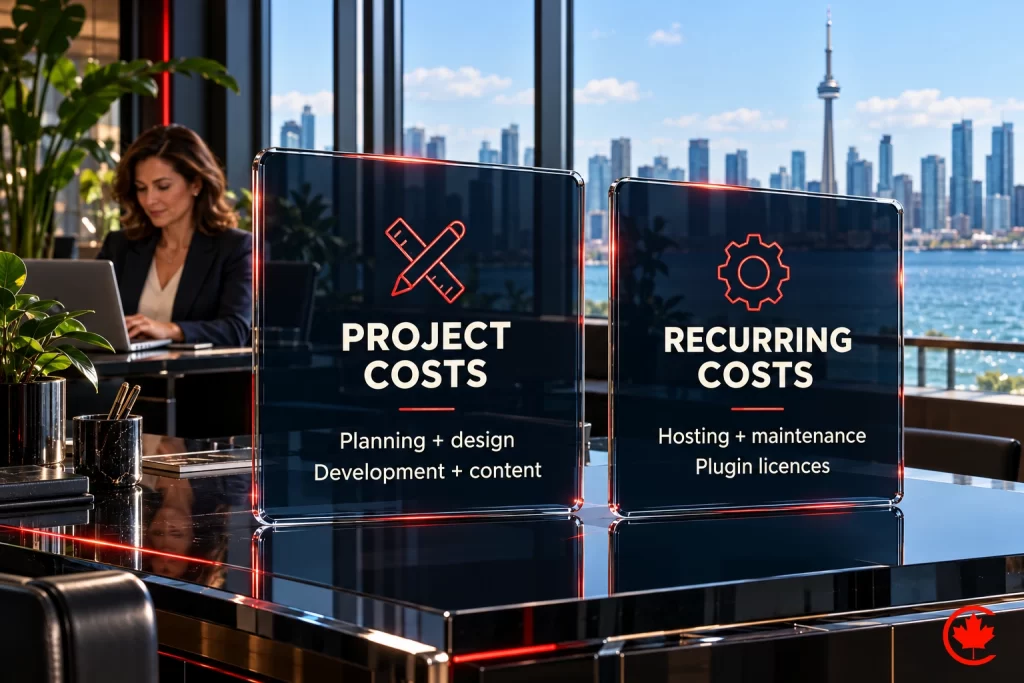
The build is a one-time cost. The site then has running costs every year, and a fair budget counts both.
These are general Canadian market ranges, not Canada Create prices. Canada Create quotes every project in writing after a free consultation.
| Ongoing item | General Canadian market range | What it covers |
|---|---|---|
| Domain name (.ca or .com) | About $15 to $30 a year | Your address on the web; premium names cost far more |
| Hosting | About $6 to $200 a month | Server, storage, bandwidth, backups and the security of the server |
| Maintenance and updates | About $1,500 to $5,000 a year | Software and plugin updates, security monitoring, fixes and small changes |
| Builder plan (if used) | $37 to $517 CAD a month on Shopify’s standard plans; US$4 to US$99 a month on other builders | Software, hosting and support bundled by the platform |
| Ecommerce running costs | About $1,000 a year for a large store, plus card fees | Apps, payment processing, extensions and updates |
Operating costs add up to anywhere from about $25 a month to several hundred dollars a month, depending on traffic, features and how much help you need. Our post on budgeting for WordPress hosting goes deeper on that line, and Canada Create’s website maintenance and security and website hosting pages describe what the work covers.
Hidden costs that change the real total
Most budget surprises come from items that were never in the quote, or were in it only as a vague line.
- Writing and content gathering. If the quote assumes you will supply all the copy, budget either your own time or a writer.
- Photography and video. Stock images are cheap; real photos of your team, premises and work cost more and usually convert better.
- Premium plugins, themes and apps. Many have yearly licences. Ask for a list with the renewal cost of each.
- Translation. A French version for Quebec customers, or other languages for your market, is a content project in its own right.
- Data migration. Moving products, customers, blog posts and redirects from an old site takes time and testing.
- Accessibility testing. Meeting the WCAG standard takes design decisions and testing, not a widget.
- Tracking and analytics. Form, call and purchase tracking should be part of launch, not an afterthought.
- Revisions beyond the agreed rounds. Ask how a revision round is defined and how later changes are quoted.
- Marketing after launch. A new site does not bring visitors by itself; search, ads and content are separate budgets.

How to read and compare website design quotes
The most common mistake is comparing bottom-line totals without checking that the scope is the same. A $4,000 quote that includes copywriting and product setup can be better value than a $3,000 quote that leaves both to you.
Write one scope and send it to everyone
Before you ask for quotes, write one page that lists the pages you need, the features (booking, payments, forms, integrations), who writes the content, the platform if you have a preference, and the date you need to launch. Send the same page to every provider and ask each to quote against it.
Read the quote by cost category
| Cost category | What the quote should specify | Question to ask |
|---|---|---|
| Discovery and planning | Strategy session, sitemap, competitor review | What planning time and deliverables are included? |
| Design | Number of unique layouts, revision rounds, mobile design | How many layouts and revision rounds? |
| Development | Platform, integrations, forms, testing | Which features need custom development? |
| Content | Who writes, edits and sources images | Who supplies copy, photography and approvals? |
| Search and tracking | Titles, structured data, redirects, analytics | What search and tracking setup is in the launch? |
| Post-launch support | Support window, what counts as a defect | What is covered after launch, and what is maintenance? |
Questions worth asking every provider
- Who owns the domain, hosting account, website files and analytics? The answer should be you.
- Who will actually design, build and write, and where are they?
- Can you show two live sites you built for businesses like mine?
- Which yearly licences and running costs will I carry after launch?
- How will you protect my current search rankings if this replaces an old site?
- How do you test speed, mobile layout and accessibility before launch?
Warning signs in a quote
Be careful with a single total and no breakdown, “unlimited revisions” with no definition, a year of hosting folded into the design fee without being shown as a recurring cost, promises of first-page rankings, and a price that drops sharply the moment you hesitate. None of these prove a provider is poor, but each one means you are comparing on incomplete information.
Website cost in Toronto and across Canada
Labour is the largest part of any custom website, so local wage levels show up in the market. Job Bank’s figures put the median web developer wage in the Toronto region at $39.42 an hour, close to the national median of $38.46 and the Calgary region’s $40.69, while the Montréal region sits at $38.46. The differences between Canadian cities are smaller than the differences between a template build and a custom one.
What changes more in a market like Toronto is competition. In crowded categories such as law, dental, home services and real estate, a site that only looks good rarely wins enquiries; it also needs strong service pages, local search setup and fast mobile performance. That scope, not the city, is usually what moves a Toronto quote up. If your business serves Quebec, budget for French content as well. For businesses that sell across Canada, provincial tax handling and shipping rules add to the ecommerce line.
Canada Create is a Toronto agency that has designed and built websites for Canadian businesses since 2008. Its web design in Toronto, ecommerce website design, Shopify website, WordPress development and web development services each start with discovery, and every project is quoted in writing after a free consultation.
City examples of the decisions that move a website quote: Belleville, Charlottetown, Chatham-Kent, Clarington, Dartmouth, Leduc, Mirabel (en français).
How to keep a website budget under control
- Phase the build. Launch the pages and features that bring in revenue first, and add the rest once the site is earning.
- Reuse layouts. Design a strong service page template once and build every service page from it.
- Prepare content early. Projects stall most often while waiting for text and photos.
- Pick the platform for the next three years. A cheap platform you outgrow in a year costs more than the right one now.
- Keep ownership in your name. Domain, hosting, analytics and ad accounts should belong to the business.
- Budget for the year after launch. Hosting, maintenance and content updates keep the site secure and current.
A good quote is one you can read line by line, that matches the scope you wrote, and that names the running costs you will carry. With that in hand, the right choice is usually clear.
Frequently asked questions
How much does it cost to build a website in Canada in 2026?
General Canadian market ranges published in 2026 put a template-based small business site at about $500 to $5,000, a fully custom site of 10 to 15 or more pages at about $12,000 to $25,000, and a standard online store at about $5,000 to $15,000. Most small businesses land between about $3,000 and $15,000 for the build, plus yearly running costs. These are market ranges, not Canada Create prices; Canada Create quotes every project in writing after a free consultation.
How much should a full website design cost for a small business?
A complete small business site with custom design, written content, search setup and tracking usually sits in the low to mid tens of thousands on the 2026 market ranges, while a template-based site with supplied content can cost a few thousand. The biggest swing factors are custom design, the number of unique page layouts and whether the writing is included.
How much does a one-page website cost?
A landing page in Canada typically runs roughly $250 to $1,500, depending on length and features, with custom code costing more. A one-page site built for paid ads needs fast loading, a clear offer and conversion tracking, which adds design and setup time.
How much do freelancers charge to design a website in Canada?
A May 2026 Canadian guide puts freelancers at about $40 to $100 an hour, with typical projects around $1,500 to $7,000. Federal Job Bank data shows a median wage of $39.42 an hour for web developers in the Toronto region, and billing rates sit above wages because freelancers cover their own software, insurance and unpaid time.
How much does an agency charge for a website?
The same 2026 guide puts agency work at about $5,000 to $8,000 for a template-based site of 5 to 10 pages and $12,000 to $25,000 or more for a fully custom build. The higher figure pays for a team covering strategy, design, development, writing, search and testing.
How much does it cost to start a Shopify store in Canada?
On Shopify's Canadian pricing page, checked in November 2026, the Basic plan is $37 CAD a month billed yearly or $49 billed monthly, Grow is $99 or $132, and Advanced is $389 or $517, with card processing fees on top. Design, product setup and apps are separate costs if you hire help. See Shopify website design for what a build includes.
What are the monthly costs of running a website?
Expect a domain at about $15 to $30 a year, hosting from a few dollars to a few hundred dollars a month depending on the site, and maintenance at roughly $1,500 to $5,000 a year on the 2026 market ranges. Builder plans, premium plugin licences and ecommerce apps add to that. See website maintenance and security.
Is it cheaper to build a website yourself?
A builder costs less in cash, often a few hundred dollars a year, but you pay in your own time and accept the limits of the template. For a business that depends on search and enquiries, the cost of a site that does not convert is usually higher than the saving.
How much does a website redesign cost?
A redesign that rewrites content and restructures pages can cost as much as a new build. A visual refresh that keeps the structure costs less. Always budget for a redirect map from every old URL to its new page, so search rankings carry over.
Why do website quotes vary so much?
Quotes differ because the scope differs: number of unique layouts, template or custom design, who writes the content, features such as booking or payments, and the search and tracking setup. Send every provider the same written scope and compare the quotes line by line.
What should a website design quote include?
A clear quote separates discovery, design, development, content, search and tracking setup, and post-launch support, and lists recurring costs such as hosting, maintenance and licences apart from the one-time build. If a quote is a single number, ask for it to be itemized.
Does a higher website price mean better quality?
Not necessarily. A higher quote often includes more scope, such as writing, photography or integrations. Compare what each quote covers, look at live sites the provider has built for similar businesses, and ask who will do the work.
Is .ca or .com better for a Canadian business website?
A .ca tells visitors you are Canadian and is reserved for people and organizations with a Canadian presence; a .com is familiar worldwide. Both cost about the same each year. Many Canadian businesses register both and point one to the other.
How long does it take to build a website?
A template-based small business site often takes a few weeks, a custom site a few months, and a custom web application longer. Content approval is the step that most often delays launch, so preparing text and photos early saves time.
Do website costs in Toronto differ from the rest of Canada?
Job Bank wage data shows web developer medians close together across major Canadian regions, so labour costs differ less than people expect. What raises many Toronto projects is the competition in local search, which calls for more service pages, local search setup and mobile speed work. See web design in Toronto.
How does Canada Create price a website project?
Canada Create scopes each project in a discovery conversation and sends a custom proposal with fees quoted in writing after a free consultation. It does not publish set prices, because the scope of each site is different.