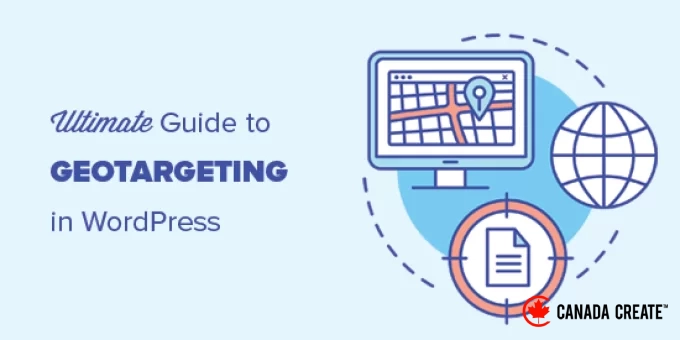
If your website attracts visitors from various regions around the globe, implementing geolocation targeting can enhance sales and user engagement. Geotargeting enables website owners to deliver personalized content tailored to users’ geographic locations.
At CanadaCreate, we have utilized geotargeting to translate our content into multiple languages, allowing users to access information in their native tongue and begin their WordPress journey. Additionally, we have employed location targeting for our marketing campaigns, which has significantly improved user experience and conversion rates.
In this comprehensive guide, we will demonstrate how to effectively use geotargeting in WordPress to increase sales and enhance customer satisfaction.
The Benefits of Geotargeting in WordPress
Geotargeting, also known as geo-location targeting, is a marketing strategy that enables businesses to provide tailored user experiences based on a customer’s geographic location.
You can customize your content, products, and website through geotargeting to make them more relevant to your customers. Studies indicate that this approach fosters user interest, enhances engagement, leads to higher conversion rates, and drives increased sales.
According to a Google study, 67% of smartphone users prefer to shop from websites that personalize information based on their location.
For example, a real estate website can utilize geotargeting to display property listings relevant to a user’s location. Likewise, an online store can provide customers with free shipping by first identifying their geolocation.
Now, let’s explore some of the simplest and most effective methods to implement geotargeting in WordPress. Here’s a brief overview of the topics we will discuss in this guide:
- How to Track User Geographic Locations in WordPress
- Implementing Geotargeting in WordPress and WooCommerce with OptinMonster
- Leveraging Geolocation Data in WordPress Forms
- Applying Geotargeting Strategies in WooCommerce
How to Track User Geographic Locations in WordPress
Before you begin geotargeting users based on their locations, it’s essential to collect data on where your users are located.
The simplest method to monitor users’ geographic locations is by using MonsterInsights. This is the top Google Analytics plugin for WordPress, enabling you to track website visitors effortlessly.
The first step is to install and activate the MonsterInsights plugin. For detailed instructions, refer to our comprehensive guide on how to install a WordPress plugin.
Once activated, the plugin will assist you in linking your WordPress site to your Google Analytics account. For detailed instructions, refer to our comprehensive guide on installing Google Analytics in WordPress.
Next, you can access your website traffic reports by navigating to the Insights » Reports section.
You can also access this report directly in Google Analytics.
Just go to User Attributes » Demographic details to view the report on top countries.
Click on each country to analyze how users from that region interacted with your website. This information allows you to refine your strategies to improve performance in underperforming areas and discover additional opportunities to boost revenue from successful locations.
Leveraging Geotargeting in WordPress and WooCommerce with OptinMonster
Geotargeting is primarily used to deliver tailored content to users based on their geographical location.
This is where OptinMonster plays a crucial role.
OptinMonster is the leading conversion optimization tool globally, designed to transform abandoning visitors into loyal customers and subscribers.
The platform includes robust display rules, such as geotargeting, allowing you to present customized messages on your website. For more information, check out our comprehensive OptinMonster review.
Begin by creating an account with OptinMonster.
Important:You must subscribe to at least the Growth plan to utilize the Geotargeting features.
Once you have signed up, navigate to your WordPress site to install and activate the OptinMonster plugin. For detailed instructions, refer to our guide on installing a WordPress plugin.
This plugin serves as a bridge between your WordPress site and your OptinMonster account.
After activation, go to the OptinMonster » Settings section and click on the ‘Connect existing account’ button.
A popup will appear where you can log in and link your WordPress site to your OptinMonster account.
With your WordPress site now connected, you can start creating your first geotargeted campaign. Navigate to the OptinMonster » Campaigns section and click the ‘Add New’ button.
First, select the type of campaign you want to create. OptinMonster offers various options including lightbox popups, floating bars, inline opt-ins, fullscreen, slide-ins, and gamified campaigns.
In this tutorial, we will create a lightbox popup campaign. You can select a campaign template by clicking on it.
Next, provide a name for your campaign.
You can choose any name you like and then click the ‘Start Building’ button.
This will open OptinMonster’s campaign builder interface, displaying a live preview of your campaign on the right.
You can easily edit, move, or delete any element in the preview by clicking on it. Additionally, you can add new elements from the left column by dragging and dropping them onto the template.
Let’s incorporate personalized geotargeted messaging into this campaign using a feature from OptinMonster called Smart Tag.
Click on a text area or add a new text block, then select the Smart Tag button in the text toolbar.
This will present you with a list of dynamic text snippets that you can include in your content.
We will include the {{city}} smart tag in our campaign. This tag will automatically identify the user’s city and display it in the campaign content.
After completing your campaign edits, navigate to the ‘Display Rules’ tab to configure when your campaign should be shown.
First, create a new Ruleset and set the condition to check for physical location.
Next, choose the criteria you want to match. For example, we want to display this campaign if visitors are located in Florida.
Click the ‘Validate’ button to ensure that your condition is correctly configured.
A popup window will appear where you need to select the specified location. Just click on the designation.
Then, click the ‘Done? Go to Actions’ button to proceed.
You will then be prompted to choose which campaign view to display and whether to apply special effects.
Click the ‘Done? Go To Summary’ button to proceed and save your ruleset.
With everything set up, switch to the ‘Publish’ tab to make your campaign live. Change the ‘Publish Status’ from Draft to Publish by clicking on it.
Remember to click the ‘Save’ button to store your campaign settings before exiting the builder.
You will then be redirected back to your WordPress site, where you can configure the display settings for your campaign.
Simply change the status from pending to published and click the ‘Save Changes’ button to launch your campaign.
You can now access your WordPress blog in incognito mode to view your campaign. Make sure you are in the targeted location to see the campaign as intended.
If you are not in the desired region, consider using a VPN service with servers in that area. This will allow you to simulate the location you want to target for your geotargeting campaigns.
Additional Geotargeting Campaign Ideas for WordPress with OptinMonster
A header bar that promotes free shipping along with a countdown timer to create a sense of urgency.
You can also implement a slide-in message aimed at local users, inviting them to request a callback from your sales team.
This is particularly beneficial for businesses that rely on phone calls for appointment bookings or for providing product information before a purchase.
Here’s an example of an inline campaign designed to help users find content that is relevant to their location.
Various restaurants and food delivery services can utilize this campaign to geotarget users and increase their conversion rates.
Leveraging Geolocation Data in WordPress Forms
Forms are essential for generating leads, engaging with customers and website visitors, and expanding your business. By using geolocation data, you can gain insights into your customers and provide them with more localized content.
To get started, you’ll need WPForms, the leading online form builder that allows you to create any type of form you require.
It includes a Geolocation addon that enables you to gather users’ geolocation data through form submissions.
First, install and activate the WPForms plugin. For detailed instructions, refer to our comprehensive guide on installing a WordPress plugin.
After activation, navigate to the WPForms » Settings page to input your license key, which can be found in your WPForms account.
Next, go to the WPForms » Addons page.
Here, click the ‘Install Addon’ button next to the GeoLocation Addon.
WPForms will automatically fetch, install, and activate the addon for you.
You can now create your first form by visiting the WPForms » Add New page, where you will enter a name for your form and select a template.
A template serves as a foundation to quickly build forms, and you can start with a Simple Contact Form.
Selecting a template will open the form builder interface, where you’ll find pre-loaded form fields based on your chosen template.
You can easily add new fields from the column on the left. Just drag and drop them anywhere on the template.
Next, click on any field to edit it, drag and drop to reposition it, or delete any form field as needed.
Once you have completed your changes, remember to click the ‘Save’ button to publish your form.
Your form is now ready to use. To start collecting Geolocation data, you need to add the form to your website.
WPForms simplifies the process of adding forms to your website. Just edit the post, page, or widget area where you want to place the form and click the (+) add new block button.
Find the WPForms block and insert it into your post.
In the block settings, select the form you created earlier. WPForms will display a live preview of your form in the content editor. You can now save your post or page and see your form in action.
How to View Geolocation Data for Your Form Submissions
After adding the form to your website, wait for it to gather a few submissions, or you can add some test entries yourself.
Once that’s done, navigate to theWPForms » Entriespage and click on your form name to see the entries. On the Entries page, click the ‘View’ link next to any entry to see the details.
On the entry details page, you will find a box displaying the user’s geographic location on the map.
Here is an example of how it will appear.
Leveraging Geolocation Data in Your WordPress Forms
Geolocation data can help expand your business by identifying which regions show greater interest in your products, services, or website.
You can correlate this data with your Google Analytics reports to identify regions that are underperforming. If your business caters to a global audience, consider providing forms in local languages.
Implementing GeoTargeting in WooCommerce
WooCommerce is the largest eCommerce platform globally, built on WordPress. It features an integrated geolocation option that detects a user’s location to provide accurate tax and shipping information.
In this section, we assume you have already set up your online store. If not, please refer to our guide on creating an online store for detailed instructions.
Next, navigate to the WooCommerce » Settings page and scroll down to the ‘General Options’ section.
You can choose the countries or regions where you offer sales or shipping. Additionally, you can adjust the ‘Default customer location’ setting.
By default, WooCommerce geolocation sets the customer’s location to ‘no location’. You can change this to your store address or use Geolocate to determine the customer’s country.
Important Note:The Geolocate feature retrieves the user’s country based on their IP address, and WooCommerce relies on a third-party service to obtain this data.
You can enable Geolocate with page cache support, but keep in mind that this may result in your product URLs displaying a v=XXXX string.
Remember to click the ‘Save Changes’ button to apply your settings.
Next, navigate to the ‘Integrations’ tab, where you will find an option to enter your MaxMind API key.
This third-party service provides GeoLocation data for your WooCommerce store.
Now, sign up for a free MaxMind account. After completing the registration, log in to your account dashboard.
From there, click on the Services » Manage License Keys menu. On the following page, click the ‘Generate New License Key’ button.
Next, copy the API key that was generated and paste it into your WooCommerce settings.
Make sure to click the ‘Save Changes’ button to ensure your settings are saved.
WooCommerce will now utilize geolocation data to determine taxes and shipping fees. However, you will still need to set up shipping zones, shipping rates, and tax configurations.
We hope this guide has helped you understand how to implement geotargeting in WordPress to enhance sales and user experience. You might also want to check out our guide on improving the organic click-through rate (CTR) in WordPress, as well as our recommendations for the best alternatives to Google Optimize.
If you enjoyed this article, please subscribe to our YouTube Channel for WordPress video tutorials. You can also connect with us on Twitter and Facebook.