

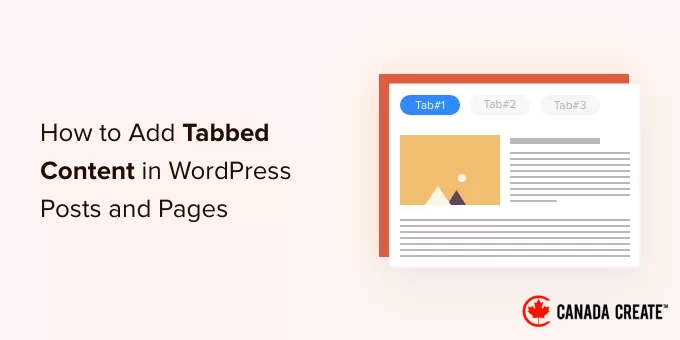
A reader recently inquired about how to organize posts into tabs to optimize space and enhance user navigation.
At Canada Create™, we have assisted numerous website owners in improving their content organization through tabbed layouts.
Incorporating tabbed content enables you to present more information about your products and services on a single page, enhancing user experience and consolidating all details in one accessible location. This approach minimizes page clutter and simplifies navigation for visitors.
In this article, we will guide you through the process of adding tabbed content to your WordPress posts and pages, ensuring that your visitors can easily locate what they are looking for.
When is it Appropriate to Use Tabbed Content in WordPress?
Utilizing tabs allows you to provide additional details in a compact space or to break up large sections of content for improved organization and user experience.
For instance, if you operate an online store, you can create tabs for product descriptions, customer reviews, technical specifications, and more. This organization presents all necessary information for your customers in one location while making the page more engaging.
You can also observe tabbed content on WordPress.org plugin pages, where the information is organized into sections using tabs such as details, reviews, installation, support, and development information.
Tabbed content enhances user engagement on your WordPress site by providing all necessary information about your products and services without redirecting visitors to another page.
Now, let’s explore how to incorporate tabbed content into your WordPress pages and posts.
We will utilize two methods to achieve this:
- Method 1: Adding Tabbed Content with a Landing Page Builder
- Method 2: Adding Tabbed Content with a WordPress Plugin
Step 1: Adding Tabbed Content with a Landing Page Builder
The most effective way to create tabbed content in WordPress is by using SeedProd, the leading landing page and website builder. SeedProd is user-friendly and features a drag-and-drop interface, ready-made templates, and extensive customization options.
For this tutorial, we will be using the SeedProd Pro license, which offers advanced blocks for adding tabbed content. There is also a free SeedProd Lite version available.
First, install and activate the SeedProd plugin. If you need assistance, please refer to our guide on installing a WordPress plugin.
After activation, you will be taken to the SeedProd welcome screen in your WordPress dashboard. Enter your license key, which can be found in your SeedProd account area.
Next, navigate to SeedProd – Create Stunning Landing PagesAccess this feature through your WordPress admin dashboard.
Then, click the ‘Create New Landing Page’ button.
SeedProd will present you with a variety of landing page templates to choose from.
Select your preferred template by hovering over it and clicking the orange checkmark icon.
A popup will appear where you can enter a title for your page in the ‘Page Name’ field and specify a permalink slug in the ‘Page URL’ section.
Afterward, click the ‘Save and Start Editing the Page’ button.
This action will open the SeedProd drag-and-drop builder, allowing you to add and modify various blocks on your template.
To incorporate tabbed content, drag the ‘Tabs’ block from the Advanced section and drop it onto your page template.
You can then customize the tab block within SeedProd.
For example, click the ‘Add New Item’ button to create as many tabs as you need, and adjust the font size, spacing, and alignment for the content in each tab.
Next, click on any tab to make further edits and add more details.
You can modify the title of each tab, add content, and change the tab icon as desired.
In addition, SeedProd offers a variety of advanced customization features.
Click on the ‘Advanced’ tab located in the left menu. Here, you can modify the tab layout, typography, colors, background colors, borders, and more.
After customizing the tab block and your landing page, remember to click the green ‘Save’ button at the top to apply your changes.
Next, navigate to the ‘Page Settings’ tab.
Then, click the ‘Page Status’ toggle to change the status from Draft to Publish.
You can click the ‘Save’ button to save your changes and exit the page builder.
Now, simply visit your website to see the tabbed content displayed on your WordPress page.
Method 2: Adding Tabbed Content with a WordPress Plugin
If you prefer not to use a landing page builder, you can utilize a specialized WordPress plugin to incorporate tabbed content into your posts and pages.
First, install and activate the Tabs Responsive plugin. For detailed instructions, refer to our guide on installing a WordPress plugin.
Once activated, navigate to Tabs Responsive » Add New Tabs in your WordPress dashboard and start by naming your tabs.
Scroll down to add as many tabs as you like by clicking the red ‘Add New Tabs’ button.
You can customize each tab by changing its title, adding a description, selecting a different icon, and adjusting the icon’s position.
Additionally, the plugin provides various ‘Tabs Settings’ options in the menu on your right.
For example, you can choose to display the tab titles, select different options for the title and icon, adjust the icon position, show or hide the tab borders, select text colors, and more.
Once you’ve made your changes, you can use the tabs in any blog post or page by utilizing the shortcode generated by the plugin.
Simply click the ‘Publish’ button to save your changes.
You can then add the tabs to any page or post using the [TABS_R id=130] shortcode. Just remember to replace the ID number in the shortcode with your specific tab ID number.
You can easily find the tab ID and shortcode by navigating to Tabs Responsive » All tabs and copying the code listed under the Tabs Shortcode column.
Next, you need to either create a new post or edit an existing one.
In the Gutenberg block editor, add a shortcode block to input the shortcode.
Next, preview your blog post or page. If everything looks good, click the ‘Publish’ or ‘Update’ button to save the tabbed content in your post.
Now, head over to your website to see the tabbed content in action.
We hope this guide has helped you learn how to add tabbed content to your WordPress posts and pages. Check out our simple guide on WooCommerce and our expert recommendations for the best WordPress plugins for business websites.
If you enjoyed this article, please subscribe to our YouTube Channel for WordPress video tutorials. You can also connect with us on Twitter and Facebook.