Many small business owners face challenges when choosing between a landing page and a full website. This decision is crucial as it impacts your ability to attract customers and expand your online presence.
Many of our readers frequently ask this question, and after assisting thousands of businesses, we have developed our own insights on the matter.
To assist you in making an informed choice, we will outline the key differences between a landing page and a website, as well as which option best suits your business requirements.
In this article, we will discuss the following topics:
- Understanding Landing Pages
- Understanding Websites
- Landing Page vs Website – Which Should You Choose?
- What Do I Need to Create a Landing Page vs a Website?
- How to Create a Landing Page for Your Business
- How to Build a Complete Website for Your Business
What Is a Landing Page?
A landing page is a dedicated web page crafted for a specific objective, primarily aimed at maximizing conversion rates. Many businesses leverage landing pages for digital marketing, pay-per-click advertising, and lead generation efforts.
Landing pages can also be utilized for various purposes such as ‘coming soon’ announcements, product sales pages, ‘request a quote’ forms, webinar promotion, and more.
Landing pages are specifically crafted to drive conversions, such as purchasing a product from your WooCommerce store or subscribing to your email newsletter. These desired actions are referred to as the page’s ‘calls to action’ (CTAs).
To enhance conversions, an effective landing page will incorporate various features that motivate visitors to take action. It’s also important to reduce distractions so that visitors can concentrate on the landing page’s call to action.
Another approach is to design your landing page as an independent website or ‘microsite.’ For instance, the image below illustrates a landing page with three distinct tabs, yet it maintains a single call to action.
What Is a Website?
A website consists of a collection of various landing pages and sections that assist users in locating the information they seek.
For instance, a standard business website might include an About Us page, a dedicated blog page, a Contact Us page, product and service pages, and more.
What Is the Key Difference Between a Website and a Landing Page?
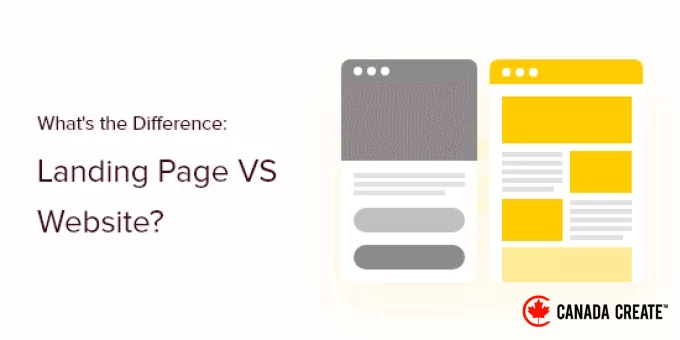
In contrast to a landing page, a website can feature multiple pages serving different purposes and objectives. While some of these pages may include a clear call to action that encourages conversions, others may not.
In contrast, a landing page is a dedicated web page created with a specific objective, typically aimed at prompting visitors to take a particular action, such as signing up for a newsletter or making a purchase.
For instance, a small business website may feature pages that provide visitors with information about its products or services. These additional pages might encourage customers to buy a product, schedule an appointment, download a brochure, or follow the business on social media.
Moreover, a single website can host multiple landing pages tailored for various marketing campaigns. For example, a membership website might promote its subscription plans on one landing page while showcasing its online courses on another.
Since a website consists of multiple pages while a landing page is singular, you’ll often notice that landing pages (as opposed to microsites) typically do not include a navigation menu.
If a navigation menu is present, it usually only links to different sections within the landing page rather than directing users to another page. This approach is a marketing tactic designed to keep potential customers focused on the content of the landing page without distractions.
A website usually includes a navigation bar that allows visitors to easily explore all the available pages. This enhances user experience and is beneficial for search engine optimization (SEO).
Landing Page vs Website – Which Should You Choose?
If you need to quickly launch a product, establish an online presence for your business, or gather registrations for an upcoming event, a landing page is a quick and straightforward solution.
On the other hand, if your goal is to create a comprehensive online presence with multiple pages, set up an online store, start a blog, and more, it’s generally better to create a full website.
If you’re uncertain, the good news is that WordPress is a highly adaptable platform, allowing you to change your approach later. For instance, you can transform a landing page into a complete website as your business expands.
Likewise, you can create a WordPress website and then develop separate landing pages for specific marketing campaigns.
What Do I Need to Create a Landing Page vs a Website?
Regardless of whether you’re building a landing page or a website, you’ll need a domain name and a web hosting account.
A domain name is the web address that users will enter to access your website or landing page, such as www.CanadaCreate.com.
Your web hosting account is where all the files for your landing page or website are stored.
Typically, a domain name costs about $16 per year, while hosting plans start at $7.88 per month, often billed annually. This can add up, making it a significant expense for new businesses just getting started.
Fortunately, Bluehost is offering a free domain name and a substantial discount on hosting services exclusively for Canada Create™ users.
In fact, you can create a landing page or even a full website for as little as $2.99 per month.
Bluehost is one of the largest hosting providers globally and is officially endorsed by WordPress.org.
After signing up for a hosting account, Bluehost will automatically set up WordPress for you. You can then log into your WordPress dashboard and start creating your website or landing page.
If you prefer not to use Bluehost, you can also install WordPress on other hosting providers like Hostinger, SiteGround, or WP Engine, following a similar process.
For comprehensive, step-by-step instructions, please refer to our guide on how to install WordPress.
How to Create a Landing Page for Your Business
The simplest way to create a landing page is by using SeedProd, the leading landing page builder available. It features a user-friendly drag-and-drop editor for effortless design.
SeedProd offers over 300 professionally crafted templates and 90 pre-designed blocks that you can easily drag and drop onto your landing pages. This enables you to design various page layouts without any coding skills.
We have a comprehensive tutorial available on how to create a landing page with WordPress. In this article, we will summarize the essential steps.
Step 1: Install SeedProd and Select a Template
Begin by installing and activating the SeedProd plugin. For detailed instructions, refer to our step-by-step guide on installing a WordPress plugin.
Important Note: There is a free version of SeedProd available, allowing you to create a landing page regardless of your budget.
However, we recommend using the pro version, as it offers additional landing page templates and integrates seamlessly with top email marketing services you may already be utilizing for sales and conversions.
Once the plugin is activated, SeedProd will prompt you to enter your license key.
You can access this information in your account on the SeedProd website. After entering your key, click the ‘Verify Key’ button.
After that, navigate to SeedProd » Landing Pages and click the ‘Add New Landing Page’ button.
Now you can select a template for your landing page.
SeedProd offers templates categorized by different campaign types, including thank you, coming soon, and 404 pages. For a landing page, you’ll usually want to choose either ‘Sales’ or ‘Lead Squeeze.’
If you’d rather create a landing page from scratch, SeedProd also provides a blank template.
To preview a design, hover your mouse over the template and click the magnifying glass icon.
When you find a design you like, click ‘Choose This Template.’ We are using the ‘Fitness Sales Page’ template in our examples, but feel free to select any template you prefer.
After selecting a template, you can enter a name for your landing page.
SeedProd will automatically generate a URL based on the title of the page, but you can customize this URL as needed.
For instance, incorporating relevant keywords into the URL can enhance your WordPress SEO by aiding search engines in understanding the content of the page.
Once you are satisfied with the information you’ve entered, click the ‘Save and Start Editing the Page’ button.
Step 2: Personalize Your Landing Page
SeedProd will now open the page builder, displaying a live preview of your template on the right and various settings on the left.
To modify any block on the page, simply click to select it in the editor. The left toolbar will then reveal all the settings for that block.
For instance, here we are updating the text within a ‘Text’ block.
You can format the text, add hyperlinks, adjust its alignment, apply CSS animations, and more using the options in the left menu.
To add additional blocks to your landing page, locate a block in the left menu and drag it into the editor.
You can then customize this block by following the same steps outlined above.
SeedProd also includes ‘Sections,’ which are pre-designed rows and block templates that can help you quickly build a landing page.
For example, if you’re creating a Google Ad landing page, you might utilize SeedProd’s pre-built Hero, Call To Action, or feature box sections.
To view all available sections, simply click on the ‘Sections’ tab.
For additional tips and tricks, explore these guides on how to enhance your landing page:
- Understanding the Key Elements of a High-Converting Landing Page: Insights from Experts
- Best Practices for Crafting Effective Call to Action (CTA) for Landing Page Success
Step 3: Link Your Landing Page with an Email Marketing Service
If you’re using an email marketing service to drive conversions, SeedProd seamlessly integrates with leading providers like Constant Contact, Brevo (formerly Sendinblue), and Drip.
To link your landing page to your email marketing service, simply click on ‘Connect.’
Next, hover over the email marketing service you use on your website and click the ‘Connect’ button when it appears. SeedProd will guide you through the process of linking your email marketing provider to your landing page.
Once you’re satisfied with the appearance of your landing page, click the ‘Save’ button and select ‘Publish’ to make it live.
Step 4: Set Your Landing Page as the Homepage for Your Domain
By default, WordPress displays your most recent blog posts on the homepage. To feature your landing page instead, you’ll need to adjust your site’s settings.
In the WordPress dashboard, navigate toSettings » Reading. Here, select the option for ‘A static page.’
To save your settings, open the ‘Homepage’ dropdown and select the landing page you previously created, then click on ‘Save Changes’.
For additional guidance, check out our beginner’s guide on creating a custom homepage in WordPress.
Alternative Option: Create a Landing Page with a Different Domain Name
As previously mentioned, a website can host multiple landing pages. However, you might want to create landing pages for different domain names.
This is particularly useful if you aim to tailor content for specific geographical regions or if you plan to enter new markets without confusing your current audience.
For example, if you run a food blog featuring cooking recipes on the domain awesomerecipes.com, and you wish to expand your business to include online cooking courses.
Instead of investing time and money into building a second website, it’s more efficient to add a custom domain and link it to a landing page on your existing WordPress site.
Although this may seem complex, SeedProd offers built-in domain mapping support, enabling you to create a landing page and associate it with any other domain name.
For detailed instructions, check out our tutorial on seamlessly adding a custom domain to your landing page using WordPress.
Steps to Build a Comprehensive Website for Your Business
WordPress is the leading website builder, utilized by millions for business websites, online stores, blogs, news outlets, and media platforms.
After installing WordPress on your hosting account, log into your dashboard to begin developing your website.
To start, add pages to your site by navigating toPages » Add New.
WordPress features a robust editor that simplifies the process of adding content to your pages. For more information, refer to our tutorial on using the WordPress block editor.
If you’re unsure where to begin, explore these articles to help you set up your pages:
- Essential Pages Every WordPress Blog Should Include
- Guide to Creating a Custom Page in WordPress
- How to Rearrange WordPress Pages Using Drag & Drop
- The Best Method to Bulk Add Posts and Pages in WordPress
Next, select a design for your website. WordPress offers thousands of free and premium themes, making it easy to create a variety of websites.
If you’re looking for assistance in selecting a theme, explore our expert recommendations for the most popular WordPress themes, or check out these excellent themes tailored for business websites.
After you’ve chosen a theme you’d like to use, navigate to Appearance » Themes and click the ‘Add New’ button to install it.
For comprehensive guidance, refer to our tutorial on how to install a WordPress theme.
Moreover, you can utilize SeedProd to design your own custom WordPress theme and create a website from the ground up. Discover more in our article on how to build a custom WordPress theme without coding.
WordPress is a versatile and user-friendly platform, but its true strength lies in its plugins.
Plugins function like applications that enhance your website’s functionality, and there are thousands available. To assist you in finding the ideal plugin, we’ve compiled a list of essential WordPress plugins for business websites.
We hope this article clarified the distinction between a landing page and a website. You might also want to check out our guide on customizing WooCommerce product pages and our expert recommendations for the best popular posts plugins for WordPress.
If you found this article helpful, consider subscribing to our YouTube Channel for insightful WordPress video tutorials. Connect with us on Twitter and Facebook for more updates.