A few years ago, the goal was ranking on page one of Google. Now a growing number of your potential customers are not scrolling through search results at all. They are typing a question into ChatGPT, asking Gemini for a recommendation, or letting Google’s AI Overview answer things before they ever see a list of links. If your business is not showing up in those answers, you are invisible to a chunk of buyers who never even open a traditional search results page.
This is a real shift, not a passing trend. AI search tools now answer millions of local, service-based questions every day, things like “who’s a good dentist near Liberty Village” or “best carpet cleaner in Richmond Hill.” Whether your business gets named in that answer depends on very specific, learnable factors, not luck.
This post breaks down how ChatGPT, Gemini, and other AI search tools decide who to cite, what separates a business that gets mentioned from one that gets skipped, and the practical steps a Toronto or GTA business can take to start showing up in AI-generated answers.
Why Getting Cited by AI Search Tools Matters Now
Search behaviour has genuinely split into two paths. There is still traditional search, where someone types a query and clicks through a list of results. And there is now a growing second path, where an AI tool reads across the web, picks out the most relevant and trustworthy sources, and gives the user a direct answer with a small number of citations attached.
Being cited in that second path carries real weight. If ChatGPT or Gemini names your business directly when someone asks for a recommendation, that is functionally a personal endorsement delivered at the exact moment someone is ready to buy. There is no scrolling past ten competitors. There is no ad clutter. It is your name, stated as the answer.
The traffic that does come through from AI citations also tends to convert well, since the person arriving already trusts the recommendation that sent them your way. The volume is still smaller than traditional organic search, but it is growing fast, and the businesses building visibility now are the ones that will have an established footprint by the time this becomes a mainstream expectation rather than an edge case.
How AI Search Tools Actually Decide Who to Cite
It helps to understand what is happening behind the scenes, because it explains almost every recommendation in this post.
Tools like ChatGPT and Perplexity use a process where they search the web (or a pre-built index of the web), pull back a set of relevant pages, and then generate an answer built from the most useful pieces of those pages. Gemini works similarly but leans heavily on Google’s own search index and Knowledge Graph, since it is a Google product.
None of these tools are reading your entire homepage and forming an opinion the way a person would. They are pulling short, specific chunks of content, usually a sentence or a tight paragraph, that directly answer the question being asked. If your content buries the actual answer under three paragraphs of introduction, there is a good chance the AI system skips your page in favour of a competitor who states the answer plainly in the first sentence.
This is the single biggest mindset shift for AI search visibility. Traditional SEO rewarded broad topical coverage and strong backlink profiles. AI citation rewards content that answers one specific question clearly enough to be lifted out and reused almost as-is.
Structure Your Content So AI Tools Can Actually Use It
Practical formatting changes that make a real difference:
- Answer the core question in the first sentence or two of a section, not the third paragraph
- Keep key claims to 40 to 60 words so they can be pulled cleanly as a standalone answer
- Use clear, declarative sentences instead of vague, marketing-style language
- Break content into sections with specific, question-style headings, since each heading can become its own citation opportunity
- Use tables, numbered lists, and bullet points wherever you are comparing options, listing steps, or presenting pricing
A dental clinic page that says “we offer a range of modern treatment options tailored to your needs” gives an AI tool almost nothing to cite. A page that says “Smile Plus Dentistry offers Invisalign, teeth whitening, and emergency dental care in Surrey, with same-day appointments available” gives it an exact, quotable answer.
Write for the Question, Not Just the Keyword
Old-school SEO trained a lot of business owners to think in keywords. AI search rewards thinking in questions instead. Structure your service pages and blog content around the actual phrasing a customer would type or say out loud, things like “how much does a root canal cost in Toronto” or “does my carpet cleaner use eco-friendly products.”
Each H2 or H3 on a page is a chance to directly and cleanly answer one specific sub-question. The more of these you answer clearly, the more surfaces you give an AI tool to pull from.
Build the Trust Signals AI Models Actually Check
AI tools weigh authority and trustworthiness heavily, especially Gemini, which inherits Google’s existing trust and ranking signals almost directly. Getting cited is not only about how your page is written. It is also about whether your business looks credible and well-established across the broader web.
Signals that consistently strengthen AI citation odds:
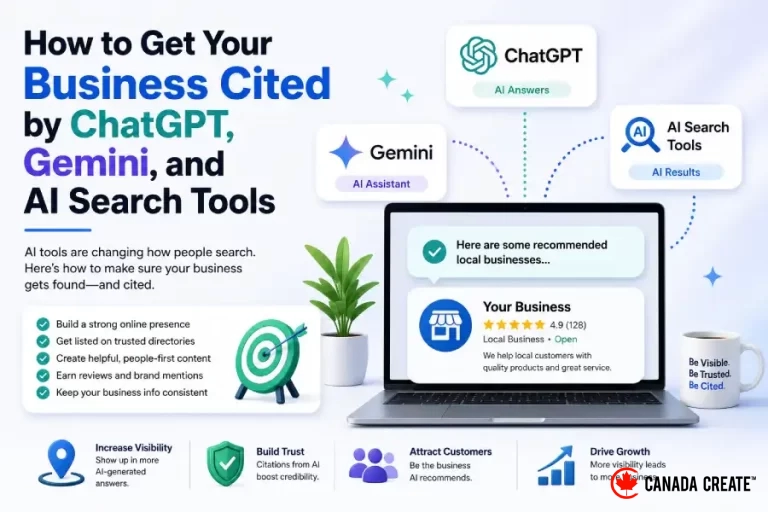
- A complete, active Google Business Profile with accurate service details
- Consistent NAP information across citation sources and directories
- Genuine, detailed customer reviews rather than a handful of generic five-star ratings
- Clear author information and real business details on your website, not an anonymous or unclear “who runs this” situation
- Coverage from local news, industry publications, or Chamber of Commerce sites that mention your business by name
If you have not already worked through this from a traditional local SEO angle, our local SEO services cover exactly this groundwork, and it happens to be the same foundation that supports AI search visibility.
Free AI Visibility Check
Not sure if ChatGPT and Gemini even know your business exists?
We will check how your business shows up across AI search tools and what it would take to start getting cited.
Call (416) 273-9030Make Sure AI Crawlers Can Actually Reach Your Site
None of the content or trust work matters if the AI tools cannot technically access your pages. This step gets missed constantly, even by businesses that have solid content otherwise.
Technical checks worth running:
- Confirm your robots.txt file is not blocking crawlers like GPTBot, Google-Extended, or PerplexityBot
- Make sure your site loads cleanly without heavy reliance on JavaScript to render core content, since some AI crawlers struggle with JavaScript-heavy pages
- Add structured data (schema markup) for your business, services, reviews, and FAQs, since this gives AI systems a clean, machine-readable version of your key facts
- Keep page load times reasonable, since crawlers, like users, can time out on slow pages
This is technical enough that a lot of business owners either skip it or get it wrong without realizing it. If your site was built or is maintained through our web design team, this kind of crawler accessibility check is something we can build directly into ongoing maintenance.
Keep Producing Content That Answers Real Questions
AI citation is not a one-time fix. It rewards businesses that consistently publish clear, specific, useful content over time, the same way traditional SEO does, just with a sharper focus on direct answers.
A steady stream of blog posts, FAQ pages, and service pages that each answer one real customer question builds up a large surface area of citable content. Over time, that consistency is what separates a business that occasionally shows up in an AI answer from one that shows up reliably across dozens of related queries.
If content production is the piece you keep putting off, our content marketing team can build that consistent publishing cadence for you, written specifically with this kind of direct, answer-first structure in mind.
Where to Start
Getting cited by AI search tools is not a separate, entirely new discipline. It builds directly on strong local SEO, clean technical setup, and consistent, genuinely useful content, the same foundation that has always driven good search visibility, just applied with a sharper focus on direct, quotable answers.
If you are not sure where your business currently stands with AI search tools, or you want a clear plan for getting there, reach out to Canada Create and we will walk you through exactly what it would take for your business.
Do I need to do anything different from regular SEO to get cited by AI tools?
Not entirely different, but the emphasis shifts. Traditional SEO rewards broad keyword coverage and backlinks. AI citation rewards short, clear, directly quotable answers placed early in each section, along with strong trust signals like consistent business information and genuine reviews.
Can a small local business actually get cited by ChatGPT or Gemini?
Yes. AI tools are frequently used for local, specific questions, things like “best plumber in Scarborough” or “dentist near me open on weekends.” A well-optimized local business page often has a real shot at getting cited for these narrower, more specific queries, sometimes more easily than for broad national ones.
How long does it take to start showing up in AI search results?
There is no fixed timeline, since it depends on how established your site already is and how competitive your industry is locally. Some businesses see AI mentions within a few months of restructuring content and cleaning up their citation and review profile, while more competitive niches take longer.
Does Google’s AI Overview work the same way as ChatGPT or Gemini?
It is closely related, since AI Overviews are built on Google’s own search and ranking systems. Strong traditional SEO, clean structured data, and clear, well-organized content all support visibility in AI Overviews the same way they support visibility in Gemini.