
PPC Advertising: How to Boost Your PPC Advertising ROI?
Pay-per-click marketing, or PPC marketing, has become crucial to digital marketing strategies. Businesses can use it to reach their target market and bring targeted website traffic. But simply running PPC campaigns is insufficient. Optimizing your PPC advertising ROI is essential to get the most return on your investment. This blog will examine strategies and best practices to boost your PPC advertising ROI.
What is PPC Advertising?
Businesses must wisely allocate their marketing budgets in the cutthroat digital environment of today. PPC advertising offers the chance to show targeted advertisements to potential customers and only be charged when someone clicks on the advertisement. A per-click model links media spend to clicks. Whether it is economical depends on qualified outcomes, acquisition costs and margins.
Online marketers who use PPC advertising place bids on keywords related to their products or services. The search engine shows the advertiser’s ad when a user enters those keywords. The term “pay-per-click” was coined because advertisers pay for clicks, with the actual cost varying by auction, bid strategy and campaign settings.
Search engines like Google and social media sites like Facebook, Instagram, and LinkedIn may display PPC ads. These advertisements are frequently seen in social media feeds or at the top or bottom of search engine results pages.
Benefits of PPC Advertising
Before talking about ROI or how to boost your PPC advertising ROI, let’s go deeper into PPC advertising by talking about its benefits.
Increased Visibility
One main benefit of PPC advertising is its capacity to give your company immediate visibility. PPC ads can appear prominently on search engine results pages, unlike organic search results, which can take some time to rank. Eligible ads can begin reaching potential customers after launch, with delivery depending on the auction and campaign settings.
Targeted Audience
You can target particular demographics, areas, and interests with PPC advertising. You can display your advertisements to people most likely interested in your products or services by identifying your target audience. Use targeting to focus delivery on relevant audiences, then check lead quality, sales and acquisition costs to see whether it is working.
Cost-Effective
PPC advertising provides excellent cost control. You can effectively manage your expenses by setting a daily or monthly campaign budget. A per-click model links media cost to clicks. Compare total acquisition cost and profit with other channels to judge cost-effectiveness.
Measurable Results
PPC advertising offers thorough metrics and analytics, allowing you to assess the effectiveness of your ad campaigns accurately. To assess the effectiveness of your marketing initiatives, you can monitor impressions, clicks, conversions, and various other key performance indicators (KPIs). As a result, you can make wise decisions and improve your campaigns for better results using this data-driven approach.
In need of professional digital marketing practices? Check out Canada Create‘s services and marketing approaches to learn more about what we do to grow your business and boost your revenue.
What is PPC Advertising ROI?
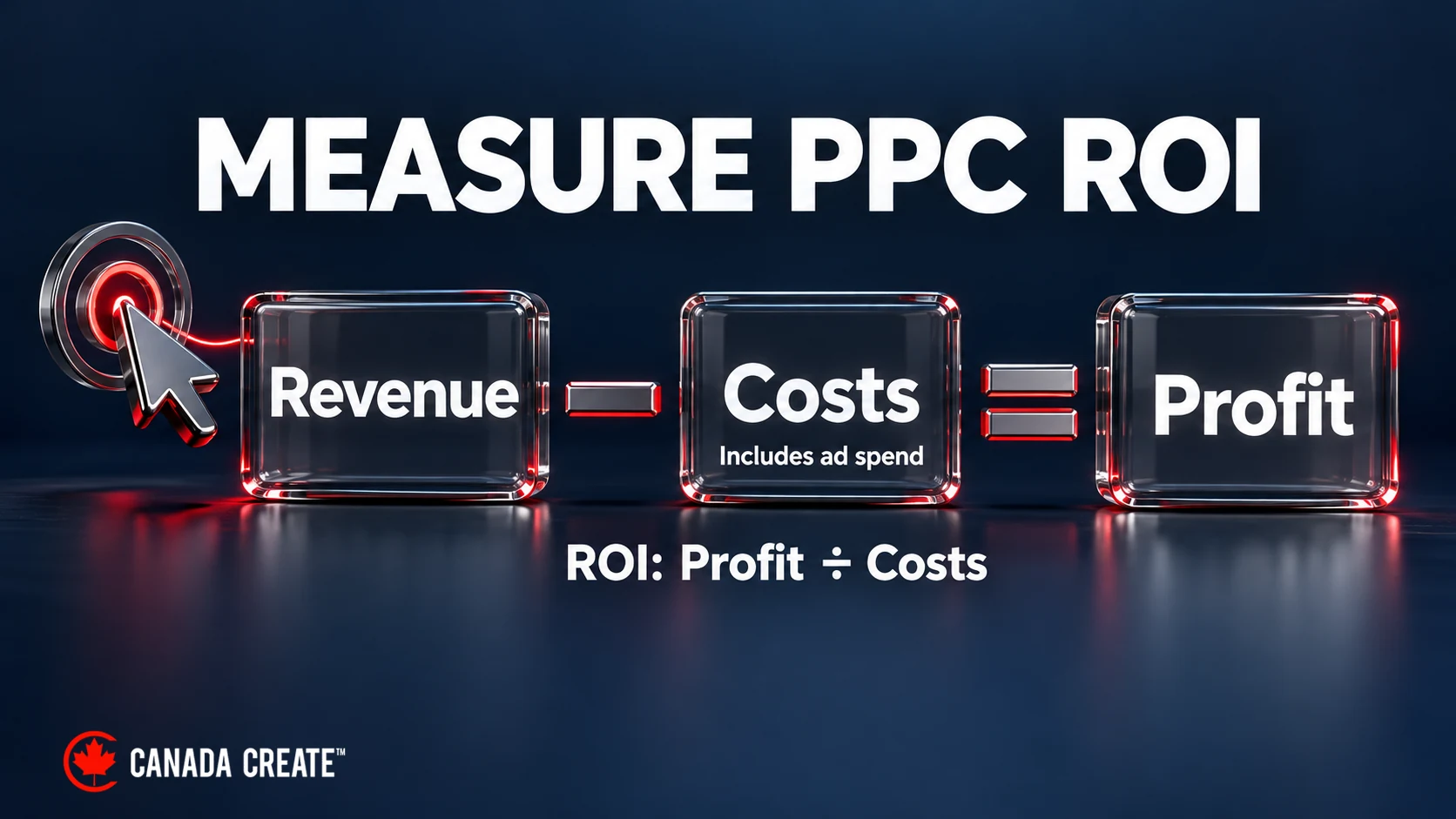
PPC return on investment measures profit relative to the costs included in your calculation. Define the reporting period and cost basis, including media, management, creative and the cost of fulfilling sales. Calculate ROI as (attributed revenue minus total included costs) divided by total included costs, multiplied by 100. Return on ad spend (ROAS) instead divides attributed revenue by ad spend; a positive ROAS does not by itself establish profit.
Why is PPC Advertising ROI Important?
For several reasons, tracking the ROI of your PPC advertising is essential. First, it enables you to evaluate the success of your campaigns, pinpoint areas that need improvement, and allocate your advertising budget sensibly. In addition, by monitoring ROI, you can identify whether your marketing is profitable and adjust your tactics using the evidence.
What Factors Affect PPC ROI?
Several factors can influence your PPC advertising ROI. These include the degree to which your sector is competitive, the standard and applicability of your keywords, the efficacy of your ad copy and landing pages, the targeting criteria you choose, and the general success of your campaigns. Therefore, to boost your PPC advertising ROI, it is crucial to consider these factors and optimize them.
Effective Tips to Boost Your PPC Advertising ROI
Pay-per-click advertising, also known as PPC advertising, is a potent digital marketing tactic that enables companies to connect with their target market and direct relevant traffic to their websites. Therefore, optimizing your strategies and tactics is crucial if you want to get the most from your PPC campaigns and boost your PPC advertising ROI. Following are some practical suggestions to boost your PPC advertising ROI:
Conduct Thorough Keyword Research
Successful PPC campaigns are built on a foundation of thorough keyword research. Choose relevant keywords that fit your target market’s needs and business goals. Use keyword research tools to compare relevant queries, including longer and more specific searches. Check current estimates for the intended location and currency, then evaluate actual click costs and qualified outcomes. Query length alone does not establish lower cost or stronger purchase intent, and keyword selection does not guarantee higher click-through or conversion rates.
Refine Your Targeting
You can reach the most appropriate audience for your products or services by refining your targeting criteria. To ensure the right people see your ads, consider variables like demographics, locations, interests, and device preferences. Then, to improve ROI, focus your targeting on a particular audience segment more likely to convert.
Optimize Your Ad Copy
Compelling ad copy is essential to get clicks, increase your conversion rate, and boost your PPC advertising ROI. You must create compelling and captivating ad headlines and descriptions that express your value proposition in detail. Also, start using pertinent keywords and a compelling call to action (CTA) to persuade users to click on your advertisement. Start testing and optimizing them frequently to increase the performance of your ads.
Improve Your Landing Page Experience
Users who click on your ads should be taken to pertinent, easy-to-use landing pages. Improve the navigation, messaging, and loading times of your landing pages. Ensure your landing page provides a seamless user experience and matches the content of your advertisement. A good landing page experience can significantly boost your PPC advertising ROI and conversion rates.
Monitor and Adjust Your Campaigns
The ROI of your PPC advertising must be continuously monitored and optimized. Review the effectiveness of your campaigns regularly, keeping an eye on crucial indicators like click-through rates, conversion rates, and cost per conversion. Determine which ads or keywords are underperforming and make the necessary adjustments. You can boost your PPC advertising ROI and increase the efficiency of your campaigns by actively managing and optimizing them.
Implement Conversion Tracking
Conversion tracking must be implemented to evaluate your PPC campaigns’ performance and boost your PPC advertising ROI. Install conversion tracking scripts on your website to monitor significant events like form submissions, purchases, and subscription sign-ups. You will be able to make data-driven decisions using this data, which will give you insightful information about the success of your campaigns.
Utilize Ad Extensions
Ad assets, formerly called extensions, are extra features that improve your ads and increase engagement opportunities. Utilize ad extensions like sitelinks, call assets, and structured snippets to give your audience more useful content. Ad extensions can raise your ads’ visibility, enhance click-through rates, and encourage conversions, which will boost your PPC advertising ROI.
Continuously Test and Optimize
To increase the ROI of your PPC advertising, testing is essential. Try various landing page designs, targeting strategies, ad formats, and messaging. To compare the effectiveness of various components and arrive at data-driven decisions, conduct A/B tests. You can find out what appeals to your audience the most by consistently testing and optimizing your campaigns, which will help you raise your ROI over time.
How to Track and Analyze Your PPC Advertising Performance?
Monitoring and evaluating the success of your campaigns is essential for calculating and improving your PPC advertising ROI. Think about the following:
Conversion Tracking
Utilize conversion tracking to monitor user behaviour after they click on your ads to track metrics like form submissions, purchases, or newsletter sign-ups and install conversion tracking codes on your website. You can evaluate the success of your ad campaigns and spot opportunities to increase ROI by tracking conversions.
Analyzing Data and Metrics
To gather information and metrics about your PPC campaigns, use the analytics tools and platforms offered by search engines and advertising platforms. Consider metrics like cost per click (CPC), conversion rates, click-through rates (CTR), and cost per acquisition (CPA). You can boost your PPC advertising ROI by using these insights to spot trends, pinpoint areas for improvement, and make data-driven decisions.
We build and run Google Ads campaigns measured on calls, forms and booked jobs, not clicks.
Making Data-Driven Decisions
Make educated decisions to optimize your advertising efforts based on the information and insights gained from monitoring and analyzing your PPC campaigns. Spend money on campaigns, ad groups, or keywords that perform well. Based on the data, modify your bidding tactics and targeting parameters. Making decisions based on data will help you increase ROI and improve campaign performance.
Common PPC Advertising Mistakes to Avoid
Certain common errors when it comes to PPC advertising can reduce your ROI. Be mindful of and steer clear of these pitfalls:
Neglecting Negative Keywords
Negative keywords assist in preventing the display of your ads for pointless searches. Negative keyword omission can result in wasted advertising dollars on pointless clicks. Review search term reports frequently and add negative keywords for better targeting and increased return on investment.
Ignoring Ad Extensions
Ad extensions offer more details and chances to interact with users. As a result, they can boost click-through rates, boost ad visibility, and boost conversions. Use ad extensions like sitelinks, call assets, and structured snippets to improve your ads and boost your PPC advertising ROI.
Lack of A/B Testing
To find the most effective version of your ads, landing pages, or CTAs, you can perform A/B testing on them. You can learn what appeals to your audience the most by testing various elements and adjusting your campaigns accordingly. Conduct A/B tests frequently to raise your PPC effectiveness and return on investment.
Overlooking Mobile Optimization
Mobile users account for a sizable portion of searches and ad clicks, significantly impacting PPC advertising. For a seamless user experience, make sure your ads and landing pages are mobile-optimized. Your ROI may suffer if you don’t optimize for mobile because of high bounce and low conversion rates.
What is the Average ROI for PPC?
Pay-per-click (PPC) advertising’s typical return on investment (ROI) varies depending on several variables, including the sector, target market, campaign goals, and efficacy of your PPC strategies. Since PPC ROI can vary greatly from one business to another, it can be difficult to give an exact average.
You must keep track of the cost of the ads, the number of conversions or sales produced, and the amount of those conversions or sales in order to calculate the ROI of your PPC campaigns. Calculate ROI using profit and the complete cost basis defined above, rather than comparing revenue with media spend alone. PPC returns vary substantially. Assess performance using a clearly defined ROI calculation, complete acquisition costs and an appropriate reporting period rather than a universal percentage target.
Is 15% ROI Realistic?
A 15% PPC ROI is a possible planning scenario, not a general benchmark. Whether it is achievable or worthwhile depends on your margins, acquisition costs, measurement period and attribution.
For an illustrative calculation, $1,150 in attributed revenue and $1,000 in total included costs produces $150 profit and a 15% ROI. Use your own cost basis and reporting period before comparing results.
Is 30% ROI High?
A 30% ROI means $0.30 profit for each $1 of included cost. For example, $1,300 revenue less $1,000 total included costs leaves $300 profit. This illustrative result is different from a 30% ROAS, and whether it is strong depends on the period, risk and completeness of the cost calculation.
How Long Does It Take to See Improvements in PPC ROI?
Depending on the campaign’s maturity and optimization efforts, a different timeframe may be required to see increases in PPC ROI. For example, it might take a few weeks to see positive results in some circumstances, while it might take several months of ongoing optimization to see noticeable improvements.
Can PPC Advertising Work for Small Businesses?
PPC advertising can be very successful for small businesses. It enables them to target particular audiences, manage their advertising budgets, and calculate their return on investment. As a result, small businesses can produce significant results and compete with larger rivals with careful planning and optimization.
Is It Necessary to Hire a PPC Agency to Manage Campaigns?
While working with professionals can provide valuable expertise and save time, hiring a PPC agency is unnecessary. PPC agencies have expertise in managing campaigns, conducting keyword research, and optimizing websites, which can help companies increase their ROI and get better outcomes.
At Canada Create, we provide top-notch PPC advertising services to help businesses maximize their online presence and boost their PPC advertising ROI. We use measurement, testing and ongoing optimization to work toward your campaign goals. Results depend on factors including competition, budget, the offer and the sales process.
Are There Any Alternatives to PPC Advertising?
Yes, there are PPC advertising alternatives. SEO, email marketing, social media marketing, and content marketing are a few well-liked substitutes. However, every alternative has advantages and things to consider, so businesses should pick the ones that best suit their objectives and target market.
How to Increase ROI on Facebook Ads?
You can use the following tactics to boost the ROI of your Facebook advertising:
- Set clear goals. Your advertising objectives should be precisely stated and coordinated with your overarching marketing goals. Having clear objectives will enable you to assess the effectiveness of your campaigns, whether they are focused on generating leads, boosting sales, or raising brand awareness.
- Audience targeting. Use Facebook’s sophisticated targeting options to connect with your target market. Demographics, interests, behaviours, and even custom audiences can all be used to narrow your audience. The likelihood of conversions increases, and ROI is improved with appropriate targeting.
- Compelling ad creatives. Ad creatives that are visually appealing and attention-grabbing should reflect the preferences of your target audience. Use crisp, persuasive copy, eye-catching images or videos, and compelling headlines to grab users’ attention and persuade them to take action.
- A/B testing. Regularly run A/B tests to test various ad components, including headlines, images, ad copy, and calls-to-action. Test different versions to see which ones perform better, then adjust your campaigns based on the findings. Your ads can be improved through this iterative process to increase ROI.
- Conversion tracking. To track users’ actions after clicking on your ads, install the Facebook conversion tracking pixel on your website. This enables you to evaluate the success of your marketing initiatives and make data-driven adjustments to raise ROI.
- Ad placement optimization. Facebook offers several ad placement options, including Instagram, the right column, and the news feed. Keep track of how your ads perform across various placements and direct your budget toward the best return on investment. You can also test out various placements to find the most efficient arrangement.
- Ad scheduling. By analyzing your audience insights, determine the best times and days when your target audience is on Facebook. Plan your advertising to run during those times to maximize visibility and engagement and increase your return on investment.
- Landing page optimization. Make sure your landing page design is attractive, responsive to mobile devices, and conversion-focused. To ensure a smooth transition and boost conversion rates, match your ads’ messaging and imagery with the landing page’s functionality.
- Continuous monitoring and optimization. Keep a close eye on the effectiveness of your ads, paying particular attention to crucial indicators like click-through rate (CTR), conversion rate, and cost per conversion. To increase ROI, implement data-driven optimizations such as pausing ineffective ads, modifying budgets, or improving targeting.
- Retargeting. Use Facebook’s retargeting features to reconnect with users who have previously expressed interest in your goods or services. Display targeted advertisements to these warm leads to remind them of your offerings and nudge them toward conversion.
Google Ads Expert in Ontario, Canada
PPC advertising provides companies with a potent method to connect with their target market and produce quantifiable results. Businesses can get the most out of their advertising budgets by realizing the value of PPC advertising ROI and implementing strategies to increase it.
To boost your PPC advertising ROI, conduct in-depth keyword research, fine-tune your targeting, optimize your ad copy and landing pages, and constantly track and tweak your campaigns. You can get better results from your PPC advertising efforts by adhering to these best practices and avoiding common blunders.
Welcome to Canada Create, your trusted partner for PPC advertising services. We are a committed group of professionals who are passionate about assisting businesses to thrive in the digital environment. We enable our clients to reach their target audience, boost brand visibility, and encourage conversions with the help of our full range of PPC solutions.
We have the solutions to fuel your success, whether you’re a small business looking to establish your online presence or a large corporation looking to scale your advertising efforts. Join forces with Canada Create to maximize the benefits of PPC advertising for your company. To begin your journey toward digital growth, get in touch with us right away.
Frequently asked questions
What is PPC in advertising, and where do PPC ads appear?
PPC advertising lets a business bid on keywords and pay when someone clicks its ad, with the actual cost set by the auction, bid strategy and campaign settings. Ads can appear at the top or bottom of search results on engines like Google. They also run in social feeds on platforms such as Facebook, Instagram and LinkedIn.
How do you calculate PPC advertising ROI, and how is it different from ROAS?
Subtract the total included costs from attributed revenue, divide by those costs and multiply by 100. Define the period and cost basis first, including media, management, creative and the cost of fulfilling sales. ROAS simply divides attributed revenue by ad spend, so a healthy-looking ROAS can still hide a loss.
What determines how much PPC ads cost?
The actual price per click varies with the auction, your bid strategy and campaign settings. How competitive your sector is, along with the quality of keywords, ad copy and landing pages, also shapes cost. A daily or monthly campaign budget controls spend, but cost-effectiveness is judged on total acquisition cost and profit.
Is PPC advertising only available through Google Ads?
No. Google is the most familiar search option, but social platforms such as Facebook, Instagram and LinkedIn also sell PPC ads. Search ads appear around the results, and social ads appear in feeds. Choose the platform by where your audience is and what you can measure.
Which PPC advertising platform gives the highest return?
No platform wins for every business. Return depends on your sector's competition, the keywords or audiences you choose, your ads and landing pages and how well you track conversions. Compare total acquisition cost and profit across channels instead of assuming one platform is always more economical.
What PPC advertising strategy helps improve ROI?
Start with keyword research tied to your market's needs, then refine targeting by location, device and audience. Write ads with a clear value proposition and call to action, and send clicks to a fast landing page that matches the ad. Install conversion tracking for forms, purchases and sign-ups, add ad assets such as sitelinks and call assets, and keep testing.
Which Google Ads PPC mistakes most often hurt ROI?
Neglecting negative keywords lets irrelevant searches eat the budget. Skipping ad assets, never running A/B tests and overlooking mobile users also drag results down. Each is fixable with regular reviews of search terms, ads and landing pages.
What should a business expect from a PPC advertising agency?
Expect working conversion tracking, reports on qualified outcomes and acquisition cost instead of clicks alone, and every ad account registered to your company wherever the platform allows. Ask who does the work and how often the account is reviewed. Since 2008, Canada Create has managed Google Ads from Toronto, judged on calls, forms and booked jobs, and it quotes fees in writing.
Is PPC advertising still effective for reaching new customers?
Eligible ads can start reaching potential customers soon after launch, and they can appear prominently above organic results. Whether that is economical depends on qualified outcomes, acquisition costs and margins. Track conversions and review the numbers regularly to know for your own business.